
Neck / Understanding Your Symptoms
Neck Pain: What It Usually Means and What to Ask
Why most neck pain settles, what stiffness, headaches and arm symptoms can point to, when to seek review sooner, and how to prepare for the conversation.
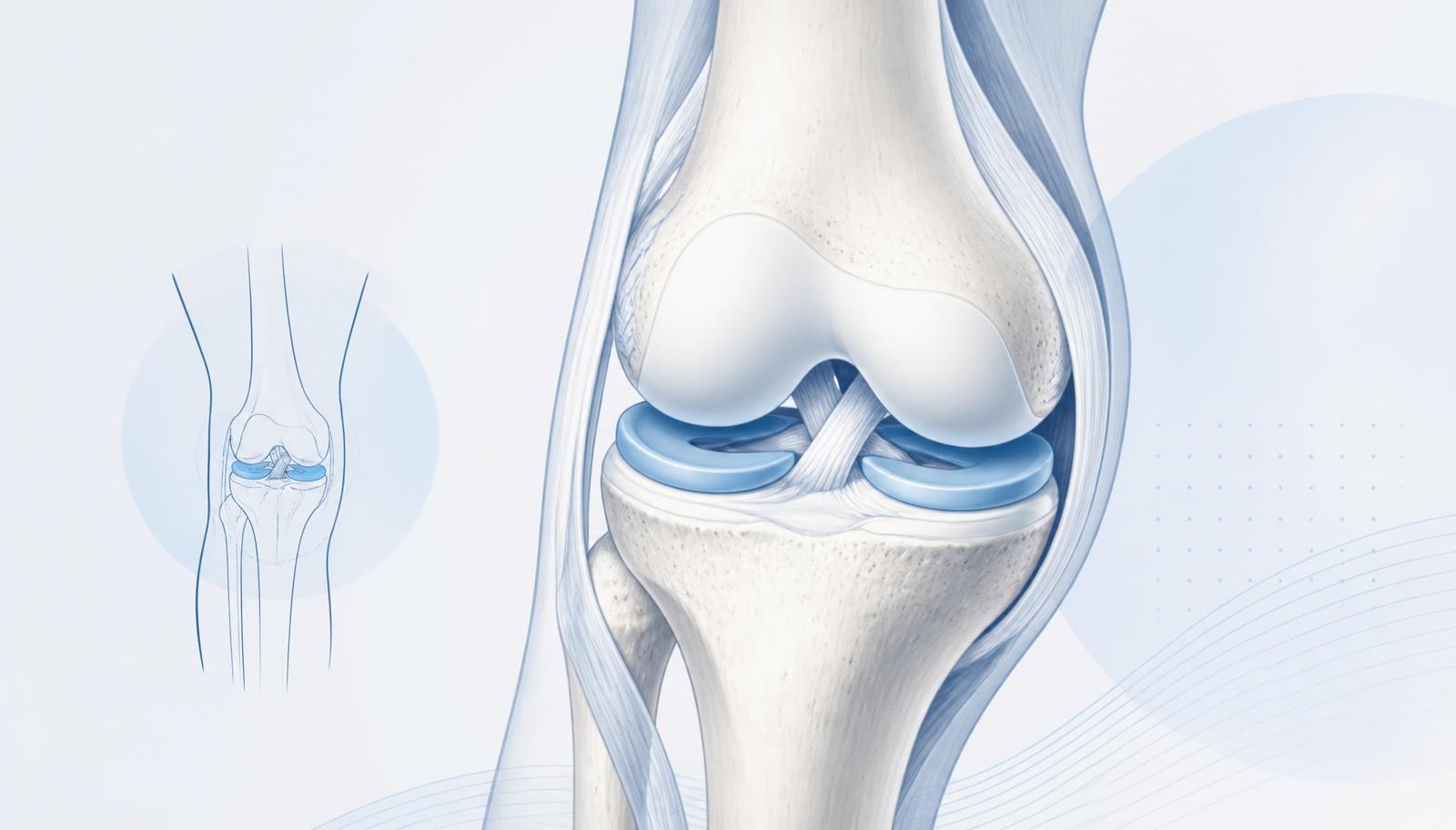
You have a meniscus tear. Do you really need surgery?
If you've ever had knee pain and an MRI, there is a good chance you've heard the words:
"You have a meniscus tear."
For many people, that immediately sounds like something is broken and needs to be fixed.
And if you are told that the tear can be seen on an MRI, it seems to make sense that removing the damaged piece might solve the problem.
But there is a problem with that line of thinking.
A meniscus tear on an MRI doesn't necessarily mean that the tear is the reason your knee hurts. And a fascinating study that has now followed people for 10 years gives us some pretty important information about whether removing these tears actually helps.
It is called the FIDELITY study.
So, what is the FIDELITY study?
FIDELITY was a study looking at people between the ages of 35 and 65 who had a degenerative tear of the medial meniscus.1
In simple terms, these weren't people who had necessarily fallen awkwardly or suffered a major sporting injury. These were more typical age-related meniscus changes that can develop over time.
There were 146 people in the original study.
The researchers split them into two groups.
One group had an arthroscopic partial meniscectomy. This is the common "keyhole" knee operation where the surgeon goes into the knee with a camera and removes the damaged part of the meniscus.
The other group had what is called placebo surgery.
They went through the process of having the operation, but the surgeon didn't actually remove the meniscus.
The really clever part was that the patients didn't know which group they were in.
This allowed researchers to ask a very important question:
Does removing the torn meniscus actually make the knee better, or do people improve simply because they have undergone an operation and expect to get better?
The researchers have now followed these patients for 10 years.
So what did they find?
The results are interesting.
At 10 years, the people who had part of their meniscus removed did not have a meaningful advantage over those who had the placebo procedure.1
In other words, removing the degenerative meniscus tear didn't appear to give people better long-term outcomes.
That is important.
Because many people do feel better after knee surgery.
The question is:
Did they get better because the surgeon removed the torn piece of meniscus?
The FIDELITY results suggest that, for this particular group of patients, the answer may be no.
And this is one of the reasons the study is so interesting.
But I've got a tear on my MRI. Surely that's what's causing my pain?
Not necessarily.
This is probably the biggest lesson I take from studies like FIDELITY.
As we get older, changes in our joints become increasingly common.
We see changes in the meniscus, cartilage, discs in the spine, tendons and other tissues.
Some of these changes can be associated with pain.
But some people have exactly the same changes on an MRI and have no pain at all.4
That means we have to be careful about assuming:
"There is a tear on the MRI, therefore the tear is causing the pain."
It sounds logical.
But the human body is a little more complicated than that.
"An MRI shows us what something looks like. It doesn't automatically tell us what is causing someone's pain."
What happens when we remove part of the meniscus?
The meniscus is not just a piece of damaged tissue sitting inside your knee waiting to be removed.
It actually has some pretty important jobs.
It helps distribute load through the knee, contributes to stability and helps the knee function properly.
So when we remove part of it, we are changing the structure of the knee.
That doesn't mean that removing part of a meniscus is always wrong.
There are situations where surgery can absolutely be appropriate.
But it does mean we should think carefully before removing tissue simply because an MRI shows a tear.
The FIDELITY researchers had previously found some concerns about changes in the knee after meniscectomy, including greater progression of certain signs of osteoarthritis at five years.2 Importantly, these findings don't mean that every person who has meniscus surgery will develop arthritis. They do, however, give us another reason to avoid unnecessary removal of meniscal tissue.
Does this mean you should never have meniscus surgery?
Absolutely not.
This is an important point.
The FIDELITY study wasn't looking at every type of meniscus tear.
It looked specifically at degenerative medial meniscus tears in people aged 35–65 who did not have advanced osteoarthritis.
That's very different from, for example, a 22-year-old football player who twists their knee and tears their meniscus during a tackle.
It is also different from someone who has a displaced meniscus tear that is genuinely locking their knee.
Those situations need to be assessed differently.
So I wouldn't take the message from FIDELITY to be:
"Meniscus surgery doesn't work."
I think the more useful message is:
"If you have a degenerative meniscus tear, surgery shouldn't automatically be the first answer."
So what should you do instead?
For many people with degenerative meniscus tears, it makes sense to first see what happens with a good rehabilitation programme.3
That might involve:
- Building strength in your quadriceps and other leg muscles
- Improving hip and lower-limb strength
- Gradually increasing how much you load the knee
- Working on movement and function
- Modifying activities temporarily if necessary
- Getting your knee used to the activities you want to return to
- Managing your body weight if that is relevant to you
- Giving the knee enough time to adapt
The goal isn't simply:
"Let's avoid surgery."
The goal is:
"Let's see what this knee is capable of before we decide that tissue needs to be removed."
And that's an important difference.
But my MRI says I have a "large" tear
This is another situation where I think it is worth taking a step back.
Seeing the words "large tear" on an MRI report can be scary.
But a large-looking tear doesn't automatically mean a large amount of pain.
Likewise, a small tear doesn't necessarily mean a small amount of pain.
The more important question is:
Does what we see on the MRI actually match what is happening with you?
That's where your history and physical examination become important.
- Where does it hurt?
- When does it hurt?
- Did it start after an injury?
- Does the knee swell?
- Can you fully straighten it?
- Does it actually lock?
- What happens when you walk, squat, run or climb stairs?
- And importantly: what happens when we start loading and strengthening it?
These questions can sometimes tell us much more about what is going on than the MRI report alone.
What I think is the bigger lesson
The FIDELITY study isn't really just about knee surgery.
It is about how we think about injuries and medical scans.
We live in an age where we can see incredibly detailed pictures of the inside of the body.
That's fantastic.
But sometimes having more information can actually make things more confusing.
You can have an abnormal-looking MRI and feel completely fine.
You can also have significant pain while the MRI doesn't show anything particularly dramatic.
That's because pain isn't simply a picture of what's happening inside your body.
Your symptoms, your history, your physical examination, your activity levels, your goals and how you respond to treatment all matter.
"An MRI is one piece of the puzzle—not the whole puzzle."
If you've been told you have a meniscus tear, ask these questions
Before jumping straight to surgery, I think it is reasonable to ask:
1. Is this a traumatic tear or a degenerative tear?
These are different problems and shouldn't automatically be treated the same way.
2. Does the tear actually explain my symptoms?
Just because something appears on an MRI doesn't mean it is the source of your pain.
3. What happens if I try structured rehabilitation first?
For many degenerative meniscus tears, this is a very reasonable option.
4. What exactly is surgery expected to improve?
Ask what you should realistically expect to be better after surgery.
5. Are there any features that make my situation different?
A genuinely locked knee or certain traumatic meniscus injuries may require a different approach.
The bottom line
The 10-year FIDELITY study adds to a growing body of evidence questioning the routine use of arthroscopic surgery for degenerative meniscus tears.
For the patients studied, removing part of the meniscus did not provide a meaningful long-term advantage compared with placebo surgery.
That doesn't mean surgery is never appropriate.
It means we should be careful about assuming that an abnormal MRI automatically means that something needs to be cut out.
Sometimes the better question isn't:
"How do we fix what is wrong with my knee?"
It is:
"How do we get this knee working better?"
And that is often a much more useful place to start.
One final thought
If you've recently been told that you have a meniscus tear, don't panic.
A meniscus tear doesn't automatically mean that your knee is damaged beyond repair, and it doesn't automatically mean you need an operation.
Get the MRI put into context.
Understand what the scan actually means.
Understand what your options are.
And make a decision based on you as a whole person—not just the picture of your knee.
Not sure what your scan means?
An MRI report can contain a lot of medical terminology, and it's not always obvious what the findings actually mean for you. INFRMD is designed to help you understand your symptoms, clinical information and medical reports in plain language, so you can have a more informed conversation about your options.
Understand My SituationYou can also read how INFRMD works or see the available options.
References & Further Reading
- 1. Arthroscopic partial meniscectomy versus placebo surgery for a degenerative meniscus tear: 10-year follow-up of the FIDELITY randomised controlled trial
- 2. Arthroscopic partial meniscectomy versus placebo surgery: five-year follow-up of the FIDELITY trial, including radiographic signs of osteoarthritis — British Journal of Sports Medicine, 2020.
- 3. Exercise therapy versus arthroscopic partial meniscectomy for degenerative meniscal tear in middle aged patients (the OMEX randomised controlled trial, with later long-term follow-up) — BMJ, 2016.
- 4. Incidental meniscal findings on knee MRI in middle-aged and elderly persons — New England Journal of Medicine, 2008.
This article is intended for general educational purposes only and is not a diagnosis or individual treatment recommendation. The information discussed relates specifically to the patient population and clinical circumstances studied in the referenced research. If you have persistent knee pain, significant swelling, instability, a genuinely locked knee, or other concerning symptoms, seek an appropriate clinical assessment.
You may also find this useful
Shoulder / Understanding Your Diagnosis
Shoulder Pain: Rotator Cuff, Impingement and What the Words Mean
Plain-language explanations of the terms used about shoulders, why a scan finding is not automatically the cause, and what usually helps first.
Coming soon
Ankle / Understanding Your Injury
Ankle Sprains and Ongoing Ankle Pain: What to Expect
How ankle sprains normally recover, why some stay sore or unstable, when an X-ray is genuinely indicated, and what good rehabilitation looks like.
Coming soon
Knee Health / Research Explained
The 10-Year FIDELITY Study: What Does It Really Tell Us About Knee Arthroscopy?
If you've been told that you have a meniscus tear, does that automatically mean you need surgery? A 10-year clinical trial provides some important answers.
Coming soon